On-site hydraulic servicing, engineering & spare parts sales


Accident-related defects in crane winches are not always confined to the externally affected area, as forces can transfer through the drive and load-holding mechanisms. In this project, a winch fitted to a borer truck had lost several operating functions following an accident. Visible cracks in the gearbox housing indicated that these forces had reached the drive assembly, but the extent of the internal damage could not be established without dismantling the winch.
The project required more than component replacement. The truck and winch were based on an ageing equipment platform with limited technical support due to unavailable original drawings and obsolete internal parts. Restoring the assembly required detailed fault investigation, recovery of serviceable equipment, manufacture of unavailable parts and verification of the rebuilt winch as an integrated system.
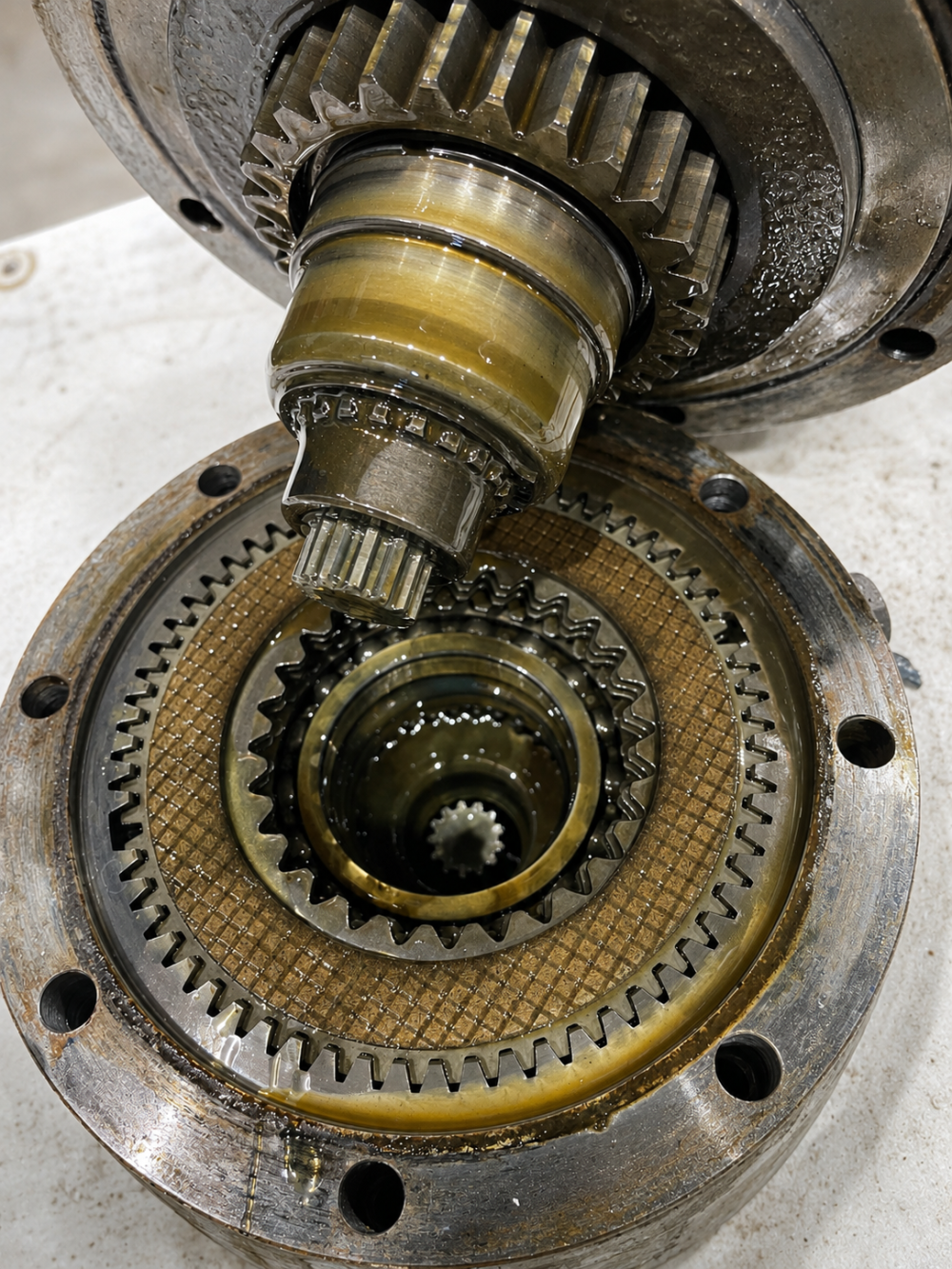
The winch was removed, dismantled and examined to establish how the accident had affected the internal load path. Particular attention was given to the interfaces between the hydraulic motor, gearbox, bevel gear drive, shafting and braking mechanisms.
The inspection identified extensive accident-related failures across the principal drive and load-holding equipment:
The combined deficiencies disrupted torque transfer and compromised the winch’s ability to control and hold load.
The replacement program relied on measurements, interfaces and functional relationships established directly from the existing assembly due to the unavailability of OEM drawings and specifications.
Critical interfaces were assessed to determine the requirements for the replacement components, including shaft geometry, bearing locations, gear engagement, connection details, brake interfaces and internal clearances.
The repair program separated recoverable equipment from components requiring complete replacement. The hydraulic motor was reconditioned, while the new bevel gear and brake assemblies were newly manufactured and fitted. A sourced main shaft completed the initial rebuild, with alignment, bearing fit, gear mesh and brake engagement checked during installation.
During the intermediate testing stage, the procured gearbox shaft sustained critical mechanical damage. Investigation established that it had not received the correct heat treatment during manufacture.
Heat treatment is critical to the performance of a loaded gearbox shaft because the material must provide sufficient strength, surface resistance and toughness without becoming excessively brittle. An unsuitable treatment can leave the shaft unable to withstand the combined torsional, bending and shock loads transmitted through the winch drive.
The failed shaft was rejected, and a new unit was engineered from the established winch dimensions and interface requirements. The replacement incorporated the correct heat-treatment specification for the mechanical loading and safety requirements of the crane winch.
Validation was completed through a staged workshop test program. Reconditioned and newly manufactured parts were first assessed independently before the winch was tested as a complete unit.
The evaluation progressed through checks of component engagement, shaft rotation, gear alignment, brake action and hydraulic motor response. Integrated trials were then used to assess torque transfer, winch control and the interaction between the hydraulic drive, gearbox and brake mechanisms.
This staged process also allowed the replacement shaft to be assessed under the mechanical demands generated by the assembled winch rather than relying solely on dimensional inspection.
The final test program confirmed correct operation of the rebuilt internal components and the winch system as a whole. No recurrence of the original failures was observed throughout the completed test sequence, confirming the winch had been restored to its required mechanical and hydraulic condition.
The project returned an obsolete crane winch to service despite the absence of original technical records and direct replacement parts. It also demonstrated why dimensional compatibility alone is insufficient when reproducing highly loaded transmission equipment. Geometry, material specification, heat treatment, load transfer and compatibility across the full mechanical assembly must all be resolved before the equipment can be returned to service.
Get in touch and discuss our Hydraulic Services with one of our experienced staff members.
Join 2300+ people who receive our monthly hydraulic tips, product updates and business news.